
The 2026 Chief Procurement Officer: Orchestrating Value Beyond Cost Savings From Expense Manager to Enterprise
From Expense Manager to Enterprise Value Architect: Leveraging Agentic AI and Strategic Innovation in a Volatile Economy
Executive Summary
In 2026, the global economy remains locked in a state of permacrisis—a persistent condition of structural volatility characterized by cascading, interconnected disruptions rather than isolated shocks. While the extreme inflation spikes of the early 2020s have moderated, they have given way to frequent, unpredictable swings in tariffs, commodity prices, supply availability, and geopolitical tensions. In this environment, the classic procurement directive of "cut costs at all costs" is no longer merely inadequate—it has become actively counterproductive, risking supply disruptions, eroded resilience, and missed opportunities for growth.
This whitepaper contends that the Chief Procurement Officer (CPO) must undergo a fundamental transformation: from an "Expense Management Architect" focused on transactional savings to an "Enterprise Value Architect" who orchestrates holistic value creation across the organization.
The modern CPO safeguards margins through sophisticated hedging strategies, dynamic demand shaping, and proactive risk mitigation. They unlock new revenue streams by cultivating supplier-led innovation, co developing breakthrough products, and accelerating time-to-market. Above all, they harness agentic AI— autonomous, purposeful AI systems that perceive, reason, decide, and act—to deliver unprecedented transparency, efficiency, and strategic impact.
By deploying these agentic AI agents to model "true total costs" (factoring in risk, sustainability, innovation potential, and geopolitical exposure), automate complex negotiations, and manage tail spend with precision, CPOs can dismantle longstanding information asymmetries with suppliers. This levels the playing field, turning procurement from a cost center into a proactive, revenue-generating engine that drives enterprise-wide resilience, innovation, and competitive advantage in an era of permanent uncertainty.
The stakes could not be higher: organizations that cling to outdated cost-only mindsets will struggle to survive, while those embracing this evolved CPO role will not only endure but thrive amid the permacrisis.
Section 1: The New Economic Reality—Volatility is the Baseline
By 2025, it had become undeniable: supply chain volatility was no longer a series of transient shocks but a structural, enduring condition of the global economy. The World Economic Forum's Global Value Chains Outlook 2026—released in January 2026—explicitly framed this transformation as a "fundamental rewiring of global value chains," propelled by geopolitical fragmentation, aggressive industrial policies, the energy transition, and rapid technological acceleration [1]. What began as reactive adjustments to pandemics, trade wars, and disruptions has evolved into deliberate, systemic reconfiguration of how value is produced, sourced, and delivered worldwide.
In 2026, Chief Procurement Officers (CPOs) confront a stark reality: the "Savings Ceiling." Traditional procurement levers—supplier consolidation, volume bundling, and relentless competitive bidding—have reached diminishing returns. Incremental unit-price reductions now deliver marginal impact while exposing organizations to greater fragility. According to Inverto's 2025 CPO Study, "Impact Leaders"—the top performing procurement organizations—have decisively pivoted their primary success metric away from Purchase Price Variance (PPV) toward "Value Contribution" [2]. This holistic composite measure integrates risk mitigation, supply continuity, innovation acceleration, speed-to-market, and margin protection, often tying directly to enterprise-wide KPIs such as revenue growth and profitability. These leaders outperform peers by actively shaping corporate strategy rather than merely executing cost directives.
The Architect’s Mandate has therefore shifted profoundly. Today's CPO is no longer judged by the cheapness of inputs alone but by the resilience, agility, and optionality embedded in the organization's outputs. As value chains regionalize, tariffs swing unpredictably, and critical inputs face targeted scarcity, the true cost of inaction—stockouts, production halts, delayed product launches, reputational damage, and lost market share— dwarfs the fleeting gains from a 1–2% unit price concession. In this environment, procurement must architect endurance over mere efficiency: building multi-sourced networks with built-in redundancy, embedding real time risk foresight, fostering supplier co-innovation, and prioritizing total ecosystem value over isolated transactional wins.
Organizations that do not make this transition risk being outmaneuvered in an era where reliability and adaptability have become the scarcest—and most valuable—currencies. Forward-leaning CPOs, by contrast, are elevating procurement from a support function to a core driver of strategic advantage, turning structural volatility from a threat into a differentiator.
Section 2: The CPO as Enterprise Value Architect
To thrive in this era of structural volatility, the Chief Procurement Officer (CPO) must shatter the traditional "back-office" silo and step forward as a cross-functional orchestrator—a strategic linchpin who bridges procurement with R&D, finance, sales, product development, and executive leadership. No longer confined to transactional execution, the modern CPO architects enterprise-wide value through three interlocking pillars that elevate procurement from cost containment to a proactive driver of resilience, growth, and competitive differentiation.
Pillar A: Margin Protection - The Value Architect safeguards the enterprise P&L by buying smarter, not merely cheaper. This demands sophisticated, dynamic hedging against commodity and currency volatility, coupled with demand shaping—close collaboration with product, sales, and finance teams to flexibly adjust product mixes, specifications, volumes, and launch timelines in response to real-time material availability, tariff changes, or geopolitical risks.
Evidence from leading research underscores the payoff: organizations that effectively balance cost discipline with strategic investments in supply-chain resilience consistently outperform peers in revenue growth and margin stability, even amid non-transitory shocks [3]. By prioritizing total ecosystem protection over isolated price concessions, these CPOs convert volatility from a contributor of margin erosion into a managed variable that preserves—and often expands—profitability.
Pillar B: Revenue Enablement Procurement has evolved into a genuine speed-to-market engine. By embedding procurement experts directly into agile R&D, engineering, and innovation pods, forward-leaning CPOs ensure that new products and services are engineered with viable, scalable, and resilient supply chains from Day 1. This "Design-for-Supply" (or Design-to-Value + Supply) philosophy preempts expensive late stage redesigns, mitigates launch delays, and dramatically shortens time-to-revenue.
In practice, this means early involvement in design gates to influence material choices, supplier selection, and manufacturing footprints—turning potential bottlenecks into built-in accelerators. The result: faster market entry, stronger first-mover advantages, and procurement directly contributing to top-line acceleration rather than merely defending the bottom line.
Pillar C: The Innovation Orchestrator In today's fragmented value chains, suppliers often represent the richest untapped source of intellectual property, sustainability advancements, process breakthroughs, and next generation materials. The CPO must therefore shift decisively from "Gatekeeper"—controlling access and enforcing compliance—to "Gateway"—proactively scouting, qualifying, and onboarding high-potential supplier capabilities that align with strategic priorities.
Top-tier CPOs are increasingly accountable for "inorganic growth" through deep supplier partnerships, effectively functioning as an extension of the corporate strategy and M&A teams. Insights from recent leadership studies show that elite procurement organizations are far more likely to drive innovation via supplier collaboration—leveraging co-development, joint R&D, and shared roadmaps to deliver breakthroughs that internal resources alone cannot achieve [4]. This positions procurement as a core engine of long-term differentiation, where supplier ecosystems become a strategic moat in an age of rapid technological and regulatory change.
Together, these pillars redefine the CPO mandate: orchestrate cross-functional alignment, protect and grow value under uncertainty, and transform external relationships into internal advantage. Organizations that empower their CPO in this expanded role do not merely survive permacrisis—they convert it into sustained outperformance, turning structural volatility into a platform for enduring leadership.
Section 3: The Technology Lever—Agentic AI & The "Thinking Layer"
The defining technological inflection point of 2026 is the decisive shift from Generative AI—which excels at creating content and insights—to Agentic AI, autonomous systems capable of perceiving environments, reasoning through complex goals, planning multi-step actions, and executing decisions with minimal human intervention. Unlike static dashboards or passive copilots that merely recommend, agentic agents act: they pursue objectives end-to-end, adapt in real time, learn from outcomes, and operate 24/7 within predefined guardrails. In procurement, this leap transforms the function from reactive support to proactive, always-on strategic engine—directly addressing the permacrisis by turning data overload into decisive advantage.
Driving Radical Price Transparency with Live "Should-Cost" Modeling For decades, suppliers maintained a decisive edge through information asymmetry—obscuring true margins behind opaque "market condition" justifications or incomplete cost breakdowns. Agentic AI dismantles this asymmetry at scale.
• The Mechanism: Autonomous agents continuously ingest and correlate global data streams— commodity indexes, labor rates, energy prices, freight costs, tariffs, geopolitical signals, and supplier specific inputs—to dynamically reverse-engineer a supplier’s cost structure. This generates a live, always-updating "Should-Cost" model that reflects real-time input changes, regional variations, and efficiency benchmarks.
• The Breakthrough Impact: When a supplier proposes a price increase (or resists concessions), the agent instantly validates it against verifiable input-cost deltas, flagging genuine escalations versus opportunistic margin grabs. This moves negotiations from adversarial haggling toward outcome-based or value-linked pricing, where compensation ties directly to proven value, risk reduction, or performance metrics rather than arbitrary list prices [5]. Leading adopters report sharper cost discipline, reduced surprise inflation, and stronger supplier accountability in volatile markets.
Autonomous Negotiation at Scale for Tail Spend The bottom 20% of spend—tail spend—has long been uneconomical to negotiate aggressively due to high human effort and low individual contract value. In 2026, CPOs deploy fleets of Negotiation Agents (or "bots") that autonomously engage hundreds or thousands of suppliers concurrently.
These agents:
• Initiate outreach, analyze responses, simulate scenarios, counteroffer within authorized parameters (price floors, risk thresholds, payment terms, SLAs), • Learn from every interaction to refine tactics, • Close deals automatically when outcomes meet guardrails, escalating only edge cases to humans.
Pioneering deployments (e.g., platforms like Pactum and others) demonstrate 4–8% average savings on tail categories, dramatic reduction in maverick spend, and vastly improved compliance—freeing procurement teams from low-value grind to focus on strategic supplier relationships and innovation.
The "Always-On" Predictive Watchtower Agentic systems function as a perpetual, intelligent radar—far beyond retrospective reporting. They proactively correlate disparate signals (e.g., port strikes, regional droughts, regulatory shifts, supplier financial health indicators, or social-media early warnings) to forecast disruptions before they cascade into shortages or price spikes.
• Agents model scenarios, quantify exposure, recommend preemptive actions (e.g., forward-buying inventory, qualifying alternates, reshaping demand), and execute low-risk mitigations autonomously.
• The result: CPOs gain anticipatory resilience—securing supply and locking in costs ahead of competitors, converting volatility from a reactive threat into a managed, even exploitable, variable.
In aggregate, agentic AI elevates procurement to real-time orchestration: dismantling cost opacity, scaling optimization across fragmented spend, and building predictive foresight into the enterprise nervous system. Organizations that integrate these capabilities fastest will not only weather the permacrisis—they will outmaneuver rivals by turning structural uncertainty into sustained margin, speed, and innovation advantage. The era of procurement as a cost center is over; the age of procurement as autonomous value architect has begun.
Sidebar: A Day in the Life of the 2026 Value Architect
How Human Strategy and Agentic Execution Coexist
07:30 AM – The Alert: The CPO’s dashboard flashes amber. The Risk Agent has detected a potential strike at a key logistics hub in Rotterdam. It estimates a 14-day delay for critical polymer shipments.
07:35 AM – Autonomous Triage: The Sourcing Agent immediately scans approved alternative suppliers in North America. It identifies two with available capacity but at a 12% price premium. Because this falls within the pre-set "Margin Protection" guardrails, the Agent autonomously secures 40% of the required volume to ensure business continuity.
09:00 AM – The Strategy Session: The CPO meets with the Head of Product. They review the Agent’s "Should-Cost" model for the new product line. The model reveals that while polymer costs are up, energy costs for the supplier have plummeted.
11:00 AM – The Negotiation: Armed with this data, the CPO calls the strategic supplier’s CEO. Instead of demanding a price cut, they propose a longer-term contract indexed to energy prices—a win-win structured by the AI’s data but closed by human relationships.
04:00 PM – The Innovation Review: The Scouting Agent presents a shortlist of three startups developing carbon-negative packaging. The CPO invites the top candidate for a pilot, turning a compliance requirement into a market differentiator.
Section 4: The Strategic Shift—From Policing to Partnering
In the permacrisis of 2026, where shortages, capacity constraints, and allocation decisions have become routine rather than exceptional, the "Customer of Choice" dynamic emerges as a decisive competitive moat. Suppliers—facing their own volatility, resource limits, and risk pressures—no longer treat all buyers equally. When critical materials tighten or production slots fill, they prioritize customers who are reliable, transparent, low-friction, and mutually profitable. Being "Customer of Choice" is no longer a nice-to-have relational nicety; it is a hard-edged strategic imperative that secures preferential access to capacity, innovation, pricing stability, and early warnings—often before contracts are even invoked.
True Value Propositions: From Price to Holistic Partnership - The Value Architect reorients supplier conversations away from relentless price compression toward demonstrated total value. This means strategically accepting modest premiums for suppliers who deliver outsized benefits—such as guaranteed carbon-neutral certification, reserved surge capacity during disruptions, accelerated co-innovation timelines, or dedicated R&D resources. In seller's markets, suppliers evaluate buyers as rigorously as buyers once evaluated them: ease of doing business, payment reliability, forecast accuracy, and long-term partnership potential often outweigh marginal unit-price differences. Organizations that position themselves as low-risk, high-value partners gain first call on scarce resources, turning potential shortages into competitive advantages.
Collaborative Transparency: Agentic AI as Shared Truth Engine Agentic AI should never function as a unilateral weapon for squeezing suppliers; instead, it becomes a "shared truth" ledger that builds trust and dampens volatility. Progressive CPOs proactively share AI-generated, high-fidelity demand forecasts, scenario models, and risk signals directly with strategic suppliers—creating mutual visibility that reduces the classic bullwhip effect (where small demand fluctuations amplify upstream into over-ordering, excess inventory, and strained relationships). By exposing real consumption patterns, planned promotions, and potential disruptions early, buyers eliminate supplier anxiety-driven padding, stabilize production planning, and foster open-book collaborations that lower overall system costs and improve responsiveness for both sides.
This collaborative approach, enabled by secure, permissioned data-sharing platforms, transforms adversarial negotiations into joint problem-solving, where suppliers invest more deeply in the relationship because they see tangible reciprocity.
Operationalizing the Shift: Retire Legacy Metrics, Adopt the Value Architect Scorecard To drive this evolution, the CPO must decisively abandon the outdated metrics of the past—Purchase Price Variance (PPV) dominance, sole focus on savings percentages—that optimized for a stable world that no longer exists. Steering 2026 innovation with 2015 dashboards is a recipe for obsolescence.
The following Value Architect Scorecard establishes a new, balanced baseline for performance evaluation and executive alignment:
• Supplier Preference Index (e.g., % of strategic suppliers ranking the organization as "Customer of Choice" via annual surveys) • Allocation Reliability (e.g., fill rate during constrained periods vs. market average) • Risk-Adjusted Margin Protection (e.g., volatility-adjusted P&L impact from supply events) • Innovation Velocity (e.g., time-to-market acceleration via supplier co-development; # of supplier-led breakthroughs commercialized) • Collaborative Transparency Score (e.g., % of strategic spend covered by shared forecasts/AI insights; reduction in bullwhip amplification metrics) • Total Value Contribution (composite tying procurement directly to enterprise revenue growth, resilience KPIs, and sustainability goals)
By measuring and incentivizing against these forward-looking indicators, the CPO aligns the function with enterprise strategy, signals cultural change, and positions procurement as the architect of enduring advantage in an era where supplier goodwill is the scarcest resource. In the permacrisis, the organizations that thrive are not those that negotiate hardest, they are those suppliers choose to protect first.
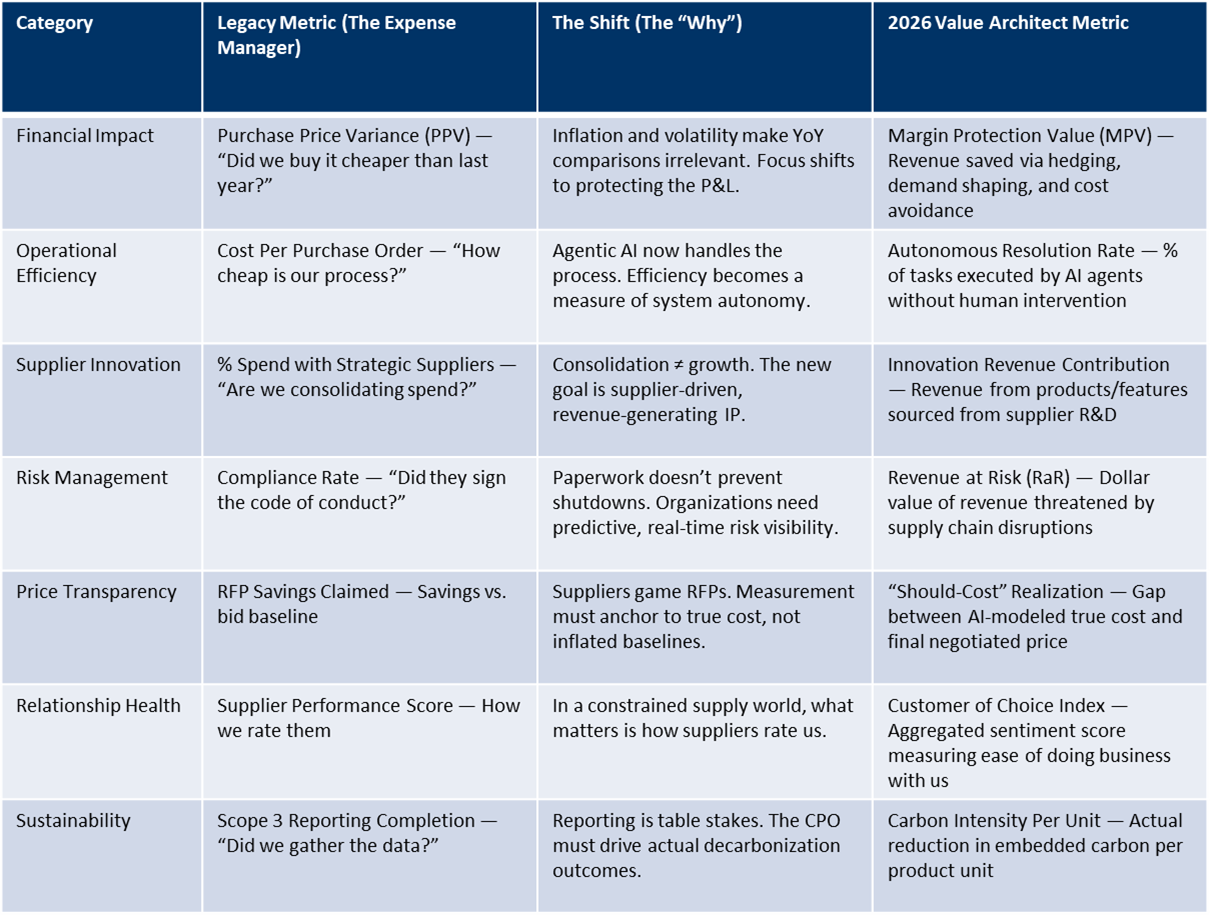
Figure 1: The Value Architect Scorecard
Comparing legacy "Expense Manager" metrics with 2026 "Value Architect" KPIs.
Section 5: Implementation Framework
To realize the full potential of the Value Architect CPO in 2026, organizations must execute a deliberate, phased transformation roadmap. This journey integrates data, talent, technology, and governance to shift procurement from tactical execution to autonomous, strategic orchestration—while preserving human oversight where relationships, nuance, and ethical judgment matter most.
The roadmap unfolds in three tightly interconnected phases, each building foundational capabilities before advancing to higher-order impact.
Phase 1: The Data Foundation – Create the Bedrock for Agentic Intelligence Agentic AI cannot reason, plan, or act effectively without high-quality, unified, real-time data. Fragmented spend systems, inconsistent supplier records, and siloed performance metrics remain the single biggest barrier to scaling AI in procurement.
In this foundational phase, CPOs prioritize:
• Consolidating spend, contract, supplier, and performance data into a clean, structured, single source of truth (often via modern data platforms or orchestration layers). • Implementing automated cleansing, classification, and enrichment processes to achieve >95% accuracy in categories, suppliers, and cost drivers. • Establishing robust data governance—defining ownership, quality standards, privacy controls, and refresh cadences—to ensure AI agents operate on trustworthy inputs.
Without this phase, downstream agentic capabilities deliver flawed outputs, erode trust, and risk compliance failures. Leading organizations treat data unification as a non-negotiable prerequisite, often achieving quick wins in spend visibility and analytics that fund subsequent phases.
Phase 2: The Talent Pivot – Evolve Humans from Executors to Orchestrators As agentic systems automate routine tasks (tail spend negotiations, should-cost modeling, routine RFx), the human role elevates dramatically—from tactical buyers chasing quotes to strategic relationship managers, data strategists, and exception handlers.
This pivot requires intentional upskilling and role redesign:
• Reskill existing teams in data literacy, AI interpretation, supplier psychology, cross- functional collaboration, and strategic category thinking. • Attract hybrid talent—profiles blending procurement domain expertise with analytical fluency and change leadership. • Redefine success: buyers now own long-term supplier partnerships, emotional capital, innovation co creation, and oversight of AI decisions—focusing energy on high-judgment exceptions (e.g., geopolitical escalations, ethical dilemmas, or breakthrough collaborations) that agents flag but cannot resolve alone.
The outcome is a leaner, more empowered function where humans amplify AI's speed and scale, while preserving the irreplaceable elements of trust, creativity, and relational depth that secure "Customer of Choice" status.
Phase 3: Governance & Rules of Engagement – Safeguard Autonomy with Strategic Guardrails Agentic AI's power lies in its ability to act independently, but unchecked autonomy risks short-term opportunism at the expense of long-term relationships, brand reputation, or regulatory compliance.
This phase establishes a mature governance framework:
• Define clear "Rules of Engagement"—pre-set parameters for pricing floors/ceilings, escalation triggers, ethical boundaries (e.g., no aggressive gouging even if data allows), sustainability mandates, and relationship-impact scoring. • Implement human-in-the-loop or human-at-the-helm models for high-stakes decisions, with transparent audit trails and explainability. • Create cross-functional oversight (procurement, legal, finance, risk, sustainability) to review agent performance, refine policies, and evolve guardrails as markets shift. • Embed continuous monitoring and feedback loops so agents learn from human interventions without drifting from strategic intent.
Strong governance prevents AI from commoditizing relationships or eroding supplier goodwill—ensuring that autonomy serves enterprise resilience, not just transactional wins.
These phases are not strictly linear; they reinforce one another iteratively—cleaner data accelerates talent effectiveness, empowered humans refine governance, and robust guardrails unlock greater agentic scope.
Organizations that invest in this structured roadmap do not merely adopt agentic AI—they institutionalize procurement as the always-on architect of value, turning permacrisis volatility into a platform for sustained outperformance. The future belongs to those who build the foundation, empower the people, and govern the machines wisely.
Conclusion: The Future is Orchestrated
The CPO of 2026 stands at a defining crossroads—one that will decide whether procurement remains a reactive, cost-focused back-office function or ascends to a proactive, boardroom-level driver of enterprise success.
One path leads to the traditional "Expense Manager" role: clinging to outdated playbooks of consolidation, competitive bidding, and incremental savings targets. In an era of structural volatility—marked by persistent tariff swings, targeted scarcities in critical materials, geopolitical fragmentation, and unpredictable disruptions, this approach is increasingly futile. Legacy levers yield diminishing returns, expose organizations to chronic fragility, and fail to address the true costs of inaction: stockouts, delayed launches, eroding margins, and lost competitive edge. Organizations that double down here risk being perpetually on the defensive, outmaneuvered by more agile rivals.
The alternative path is far more transformative: embracing the mantle of "Enterprise Value Architect"—a strategic leader who orchestrates cross-functional value creation amid permanent uncertainty. This evolved CPO leverages agentic AI not as a mere efficiency tool, but as the backbone of radical transparency, predictive foresight, and autonomous execution. Agentic systems deliver live should-cost modeling to dismantle supplier information asymmetries, scale intelligent negotiations across tail spend, and operate as an always-on watchtower that anticipates volatility before it materializes.
Crucially, this role extends beyond cost containment to proactive value generation:
• Safeguarding and expanding margins through demand shaping, dynamic hedging, and risk-adjusted resilience. • Accelerating revenue by embedding procurement in innovation pods, enforcing "Design- for-Supply," and unlocking supplier-led breakthroughs. • Cultivating "Customer of Choice" status through collaborative transparency—sharing AI- powered forecasts and insights to reduce bullwhip effects and secure preferential access during shortages.
In 2026, leading CPOs are no longer measured solely by savings percentages; they are evaluated on total value contribution—resilience under pressure, speed-to-market gains, innovation velocity, and enterprise-wide risk mitigation. Industry outlooks from sources like the World Economic Forum, KPMG, Gartner, and ProcureCon underscore this shift: procurement is evolving into a strategic core function, with agentic AI enabling "always on" operations, elevating human roles to exception handling and relationship orchestration, and positioning CPOs as geo-business stewards who turn volatility into momentum.
The choice is stark and urgent. Remain an Expense Manager, and procurement fades into irrelevance amid structural chaos. Step forward as an Enterprise Value Architect, and procurement becomes indispensable—a boardroom imperative that architects endurance, fuels growth, and secures competitive advantage in the permacrisis era.
The future will belong to those who choose transformation over tradition. For forward-leaning organizations, 2026 marks not just survival, but sustained leadership.
References
1. World Economic Forum. (2026). Global Value Chains Outlook 2026: Orchestrating Corporate and National Agility. Geneva: WEF.
2. Inverto (BCG). (2025). The Strategic Evolution of the CPO: From Cost Savings to Value Creation.
3. Sphera. (2026). Supply Chain Risk Report 2026: Preparing for Structural Volatility.
4. Products That Count. (2025). The 2025 CPO Insights Report: Product Leadership in a New World Order.
5. ScholarSpace. (2025). Pricing Models for Agentic AI Services: A Multi-Sided Market Analysis. University of Hawaii.
6. Journal of Information Systems Engineering and Management. (2025). Agentic AI in Procure-to-Pay: Opportunities, Challenges, and a Roadmap for Autonomous Procurement Systems.
