The 3 Big Things We Are Watching In Supply Chain Management This Week
For supply chain leaders and their C-suite counterparts, mid-2026 has proven that structural volatility is the new baseline. The operational playbook is rapidly shifting from post-pandemic stabilization to proactive risk management. Driven by inflationary pressures, looming regulatory deadlines, and the complex realities of regionalized trade, procurement teams are actively rewiring their networks to protect both margins and market access.
The critical nature of these maneuvers was underscored last week by the Bureau of Labor Statistics' May 2026 inflation reports. With the Producer Price Index (PPI) jumping to a 6.5% year-over-year increase—the highest level in over three years— and the Consumer Price Index (CPI) accelerating to 4.2%, the data confirms that inflationary pressures are not just lingering; they are escalating.
Here are the three macroeconomic and operational trends commanding our attention this week considering this new economic data.
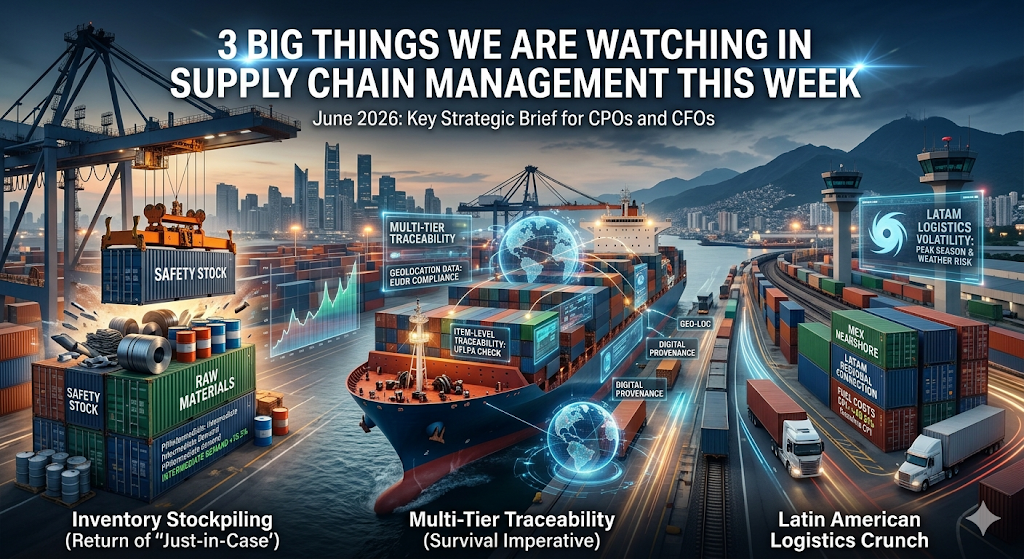
1. The Return of Just-in-Case: Safety Stockpiling Hits a Three-Year High
After two years of aggressively unwinding inventory to optimize balance sheets, manufacturers are reversing course. The latest data from the GEP Global Supply Chain Volatility Index indicates that global safety stockpiling has surged to its highest level since the peak of the 2021–2023 crisis.
This behavior is completely validated by last week’s PPI report. In May, prices for processed goods for intermediate demand jumped 13.3% year-over-year, and unprocessed goods for intermediate demand skyrocketed 22.2%. Procurement teams aren't just guessing; they are watching wholesale input costs surge in realtime. By aggressively accelerating raw material purchasing now, they are executing a deliberate hedge against anticipated second-half inflation and worsening global material shortages.
The Executive Takeaway: This trend forces a direct confrontation between supply assurance and working capital management. CFOs and Chief Procurement Officers (CPOs) must collaboratively assess whether current inventory builds are calibrated correctly against actual Q3 and Q4 demand signals. Hedging against a 13.3% rise in intermediate goods makes sense, but over-hedging risks trapping vital cash just as consumer price elasticity is tested by the 4.2% CPI increase.
2. Multi-Tier Traceability: From Best Practice to Survival Imperative
The grace period for supply chain opacity is ending. Global regulatory frameworks are rapidly shifting multi-tier traceability from a corporate sustainability initiative to a strict requirement for market access.
The most pressing catalyst is the European Union Deforestation Regulation (EUDR), which becomes fully enforceable for large and medium-sized operators on December 30, 2026. The EUDR mandates that companies trading in commodities— such as soy, cocoa, palm oil, and derived goods—provide precise geolocation data proving their products originate from deforestation-free land. Concurrently, the rigorous enforcement of the Uyghur Forced Labor Prevention Act (UFLPA) in the United States continues to hold shipments at customs unless item-level, Tier-3 provenance can be verified.
The Executive Takeaway: Non-compliance in 2026 is an existential revenue threat; products lacking structural due diligence statements will simply be locked out of major markets. Furthermore, achieving this compliance is introducing new structural costs precisely when the CPI and PPI indicate that passing additional costs to consumers is becoming more difficult. Immediate capital must be allocated to digital traceability infrastructure capable of capturing geolocation data, automating supplier risk evaluations, and providing regulatory-grade proof of origin without destroying margins.
3. The Latin American Logistics Crunch: Shifting Peaks and Weather Volatility
The strategic pivot toward nearshoring is creating severe operational bottlenecks in Latin America. As production volumes surge in Mexican manufacturing hubs like Monterrey and Querétaro, the US-Mexico cross-border logistics network is experiencing unprecedented strain. Major freight corridors are facing tightened trucking capacity and heightened competition for warehouse space.
Compounding this infrastructure friction is a severe shift in traditional shipping seasonality and surging fuel costs. Last week's CPI data revealed a staggering 40.5% year-over-year increase in gasoline prices, with energy commodities broadly up 40.6%. This fuel spike is drastically inflating inland transit costs. At the same time, shippers are front-loading Asia-to-Latin America cargo to secure capacity ahead of Q4 commercial events. This premature peak is colliding with the impending Caribbean and Gulf hurricane season (August–October) and heavy seasonal rainfall across Central America, threatening to fracture inland connectivity.
The Executive Takeaway: Nearshoring remains a sound long-term strategy for geopolitical risk mitigation, but immediate execution requires agility. Executives must adjust their regional transit expectations and budgets to account for both severe weather delays and surging diesel costs. Relying on spot-market trucking or last-minute bookings across the US-Mexico border is no longer viable. Success requires securing contracted capacity, executing robust customs pre-clearance protocols, and building dynamic routing contingencies.
4. About the Firm and Contact Information
Supply Chain Intelligence, LLC is a boutique procurement consultancy dedicated to providing objective, analytical, and procedural advisory services. Founded by John G. Taylor, the firm leverages over 20 years of Fortune 100 corporate procurement leadership, including a decade navigating complex global sourcing ecosystems at Citigroup. Driven by a highly disciplined approach rooted in Naval Aviation service, the firm specializes in identifying operational inefficiencies and structuring actionable, data-backed solutions for executive leadership.